No products in the cart.
Return To Shop

No products in the cart.
Return To Shop
No products in the cart.
Return To Shop
Bridge to Global Literature
No products in the cart.
Return To Shop
Bridge to Global Literature
No products in the cart.
Return To Shop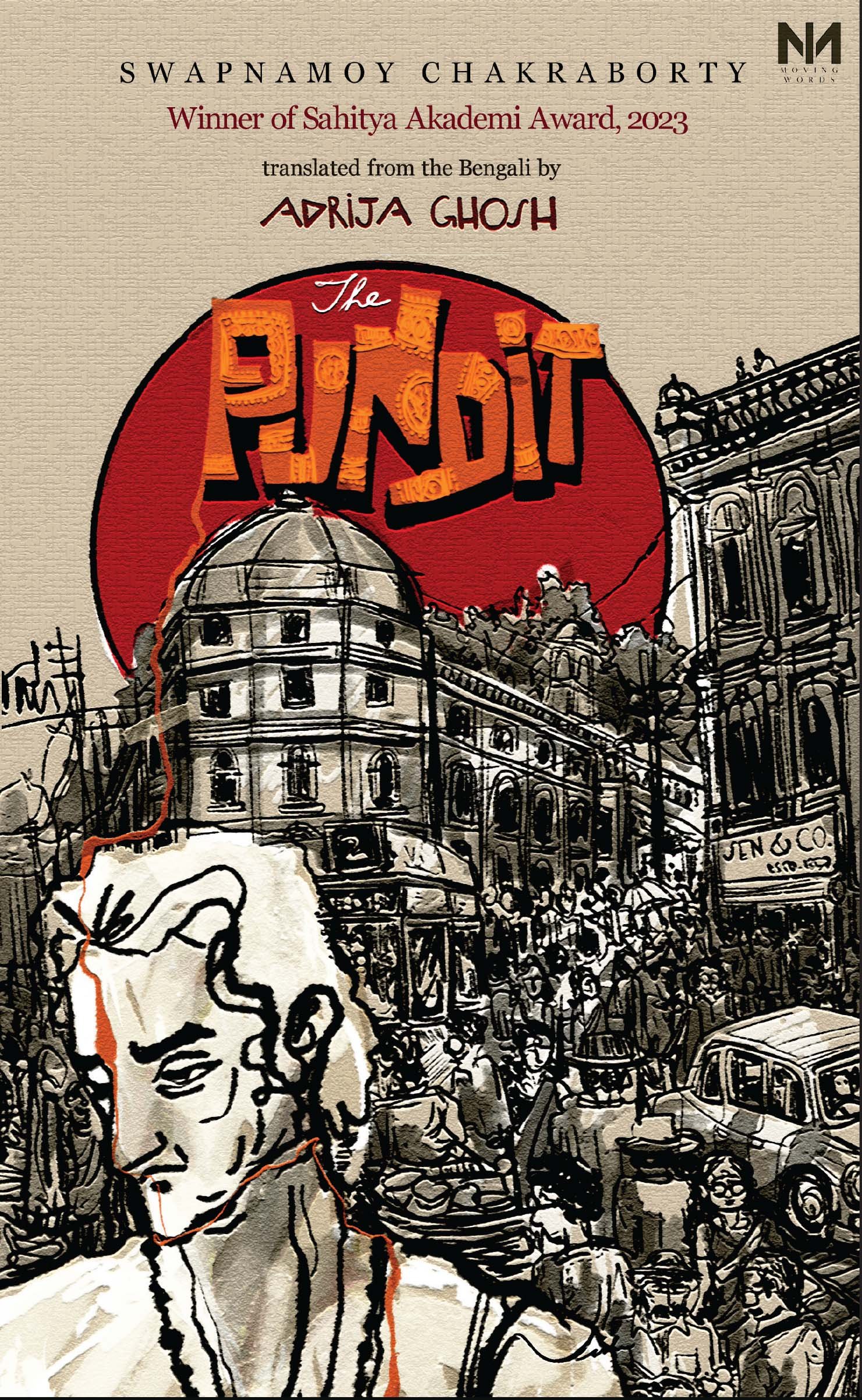
₹349.00
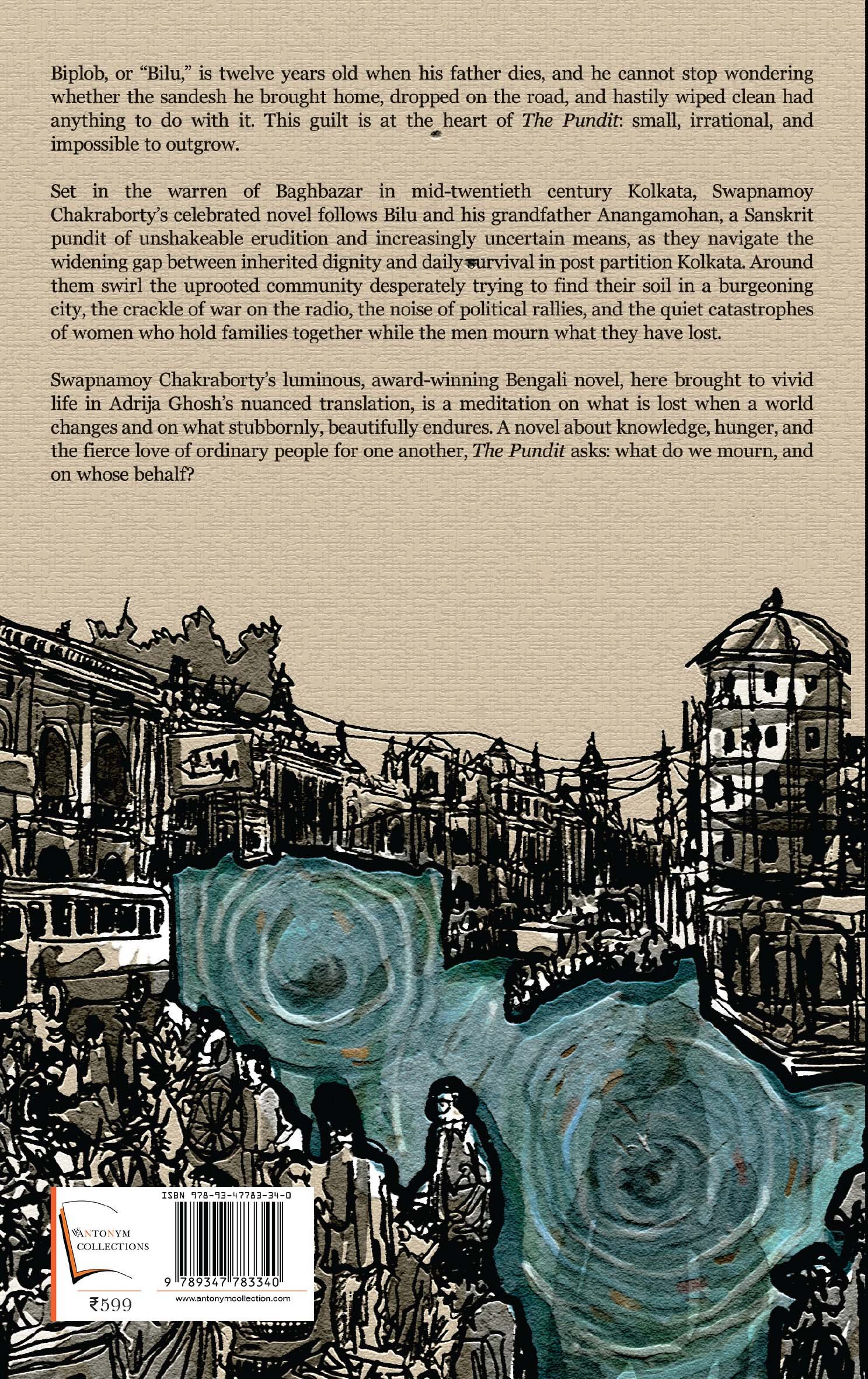
A boy blames himself for his father’s death. Swapnamoy Chakraborty’s The Pundit weaves caste, poverty, and faith into 1960s Bengal’s fading world.
49 pre-orders available
| Author(s) | |
|---|---|
| Translator(s) | |
| Format | |
| Language | |
| Pages | 316 |
| ISBN | 9789347783340 |
In a crumbling, century-and-a-half-old house in post-Independence Calcutta, a Brahmin boy named Biplob—Bilu to those who love him—is being made twice-born. His sacred thread ceremony marks him as a dwija, veiled from the faces of the unworthy, forbidden eggs and onions, handed a begging staff of bael wood. But the rituals his grandfather Anangamohan guards so fiercely are already dying, and Bilu knows it. What he cannot shake is a quieter, more terrible conviction: that he is somehow to blame for his father’s death.
Swapnamoy Chakraborty’s The Pundit is a coming-of-age novel of rare tenderness and unsparing honesty. Through Bilu’s watchful eyes, an entire vanishing world comes alive—the ink-pellet factory downstairs, the neighbours’ Trincal frocks and pump shoes, the Friday-night radio play glimpsed through a rival family’s window, the Netaji songs sung each January on the veranda. It is a childhood measured in what the family cannot afford: a radio, a new dress, two pieces of sandesh.
Beneath the period detail runs a deeper current. This is a story about caste and its slow unravelling, about the crushing weight of Brahmin honour on a household with no money to sustain it, and about a mother’s fury and a father’s exhausted, unkept promises. Chakraborty writes poverty not as spectacle but as texture—the false mosquito net stitched from donated gamchhas, the shame of a growing boy’s endless hunger.
At once intimate and expansive, The Pundit captures a Bengal caught between memory and modernity, faith and disillusion, the sacred and the merely survivable. It is a portrait of a boy learning that the men who are meant to be his gods are only, in the end, men.
One of the most renowned literary voices of contemporary Bengali prose, Swapnamoy Chakraborty was awarded the prestigious Sahitya Akademi award for his novel Jaler Upar Pani in 2023. With a prolific writing career spanning over five decades, he has had the unique honor of being both critically acclaimed and wellreceived by Bengali readers. Among other recognitions, his novel Abantinagar won the Bankim Puraskar in 2005. He has over thirty novels and numerous short stories to his name. He lives in Kolkata.
Adrija Ghosh, a poet and translator, is currently pursuing a PhD in English at the University of St Andrews, United Kingdom. Adrija has published two poetry pamphlets, heir of sisyphus (2023) and the commerce between tongues (2022) with Broken Sleep Books, and debuted as a literary translator with Tilottama Majumdar’s The Prisoner (translated from the Bengali to English) in 2024, published by The Antonym Collections. Adrija holds an M.Sc. in Comparative Literature from the University of Edinburgh and an M.A. in Creative Writing from the University of East Anglia, and B.A. (H) in English from Lady Shri Ram College, Delhi University. Adrija’s work has appeared in Wasafiri, Modern Poetry in Translation, bath magg, Gutter, The Dark Horse, among others. In May 2022, Adrija was awarded a translation residency at Dragon Hall, Norwich, by the National Centre for Writing. In 2021, Adrija wrote the short-film Sifr, which was named runner-up for the Kashish QDrishti Film Grant.
 The Pundit by Swapnamoy Chakraborty
Share this product with others

Reviews
There are no reviews yet