No products in the cart.
Return To Shop

No products in the cart.
Return To Shop
No products in the cart.
Return To Shop
Bridge to Global Literature
No products in the cart.
Return To Shop
Bridge to Global Literature
No products in the cart.
Return To Shop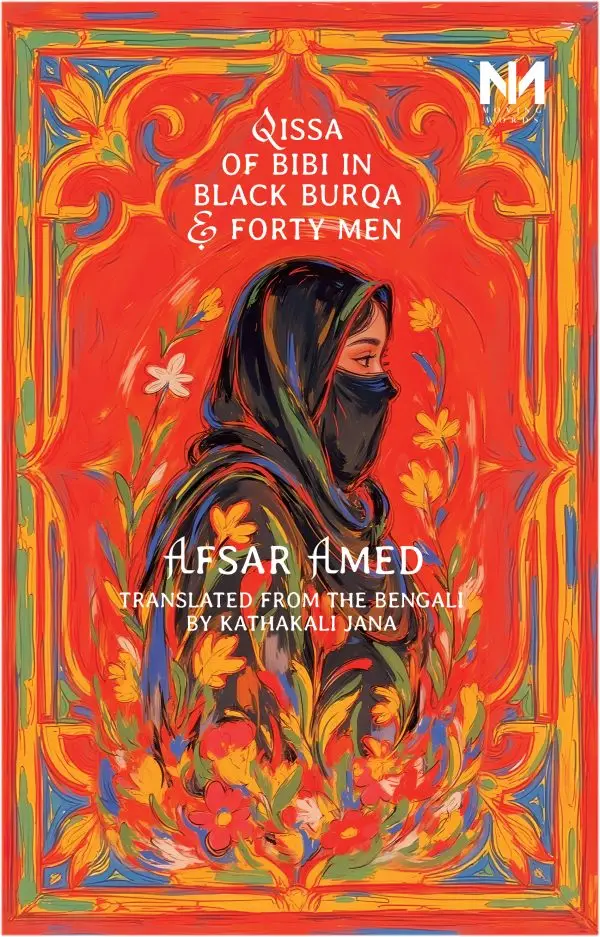

₹425.00
Qissa of Bibi in Black Burqa and Forty Men by Afsar Amed is a Poetic Journey of Memory, Womanhood, and Mystical Resistance.
In stock
| Author(s) | |
|---|---|
| Translator(s) | |
| Language | English |
| Format | Hardback |
| Pages | 184 |
| ISBN-13 | 9788198441393 |
For readers of Arundhati Roy’s The God of Small Things and Elif Shafak’s The Forty Rules of Love comes a bold and poetic exploration of memory, womanhood, and inner transformation.
This Indian magical realism novel blends fiction of mystical resistance with lyrical prose, offering a rare journey through the symbolic and emotional.
Bibi walks cloaked not just in a black burqa, but in veils of emotion, silence, and stories untold.
Her path intersects with forty archetypal male figures—each representing love, power, longing, trauma, and healing. What unfolds is a collection of South Asian literary fiction that is deeply introspective, stylistically experimental, and emotionally rich.
Rooted in the cadence of traditional qissas, the narrative moves with a quiet rhythm, evoking dreamlike transitions where past and present blend.
As Bibi navigates inner landscapes filled with memory and myth, the book reflects on what it means to be a woman in a world of watching eyes, quiet resistance, and buried truths.
This feminist literary fiction is not just symbolic—it’s alive with metaphors drawn from South Asian traditions and psychological fiction by Indian authors.
Written in poetic, luminous language, Qissa of Bibi in Black Burqa and Forty Men belongs on the shelves of readers seeking books about inner journeys, strong female characters, and magical realism fiction rooted in cultural identity.
Read a review by The Sunday Statesman: Click here
Read a review by The Statesman: Click here
Read a review by the Asia News Network: Click here
Afsar Ahmed, 5 April 1959 – 4 August 2018 was an Indian Bengali writer. His literary career started with writing poetry, soon to change course into prose. His work Bangali Musalmaner Biyer Gan was published in Porichoy in 1978.His first novel Ghor Gerostiwas published in 1980. His writings garnered the attention and wide accolades from Bengali literary circle. His works were published regularly in Porichoy, Kalantor, Baromas, Saroswato magazines. Besides writing he also worked in literary magazine Protikshon for some years. He worked in Paschimbanga Bangla Akademi too. Amed’s book Bibir Mithya Talaq O Talaqer Bibi Ebong Holud Pakhir Kissa was in the school curriculum in Assam. Mrinal Sen directed Aamar Bhuban was based on his novel Dhan Jyotsna. He was the recipient of numerous honours and awards including Somen Chanda Puraskar from Paschimbanga Bangla Akademi in 1998. He and Kalim Hazique translated Abdus Samad’s Urdu novel Do Gaz Zamin into Bengali titled Sare Tin Hat Bhumi. He was awarded Sahitya Akademi Translation Prize for this work in 2000. He also received Bankim Puraskar in 2009. He received Sahitya Akademi Award in 2017 for his novel Sei Nikhoj Manushta
Kathakali Jana is the head of administration and events at the ITC Sangeet Research Academy in Kolkata. She also writes about the Arts in various mainstream and niche publications and engages with performing arts practitioners across genres. She wears yet another hat as a literary translator.
Sorry, no reviews match your current selections
 Qissa of Bibi in Black Burqa and Forty Men by Afsar Amed
Share this product with others

oohhh…this is one fine agency given to a burqa clad woman and how a flower and later on the incidents regarding the flower and of Rehana’s husband is a treat to read. A woman makes her burqa her weapon. not to harm but so much more. don’t miss out on this book.
“Qissa of Bibi in Black Burqa and Forty Men” is a translated work of Afsar Ahmed who probes the picture of rigid structure of identity and gender scenery where Rehana, the protagonist as a bibi explores her hidden burial of desires under the attire of Burqa out of pain and atrocities she endures in her marraige.
The story of Rehana is something I find uncanny who discovers freedom in her third marriage with a lunatic husband after first two marriages which did not last long, due to the abusive nature of husbands. Finding solace and savoring pleasure of having married a madman, she starts to like her marriage. But her freedom serves as a matter of fleeting hug to heaven while alive.
The fragrance of flower determine the main twist in the story which portrays the woman’s struggle to follow their own norms and the sexual assault faced by a woman in the house of in-laws.
The portrayal of forty men serves not just as a congest of mere characters but as a metaphor for the collective weight of male authority in the patriarchal society that defines and confines her existence. Afsar Ahmed through the context of a pervasive cultural machinery crafts the narration with playful tone to capture the suppressed voices.
Apart from that, this book speaks more of an uncomfortable truths of a traditional culture. The elements of hypocracy, misogyny, religious conservatism, and societal complicity have been denoted throughout the waves of the life of Rehana. There are some parts which is not easy for me to engulf since the constant haunting and unsettling dilemmas distracted my mind to take this as a fictional story.
A book rooted in magic realism that incorporates Bengali literature, regional landscape, mythology along with Hindi and Islamic traditions. The author follows the South Asian type of storytelling called ‘qissa’. The novels MC, Bibi is a woman who has claimed herself for the first time in her life when she is married off to a madman in her third marriage. Dealing with forty archetype of men, Bibi observed and plots from behind the veil of the burqa. The very symbol of control becomes her vantage point in her life.
The book is translated from the author’s original work in Bengali named as ‘Kalo Borkhar Bibi o Kusumer Gondho Ebong Chollishjon Lok’. Kathakali Jana has masterfully translated maintaining cultural and linguistic reverence. Magic realism, feminist fiction and social injustice towards women have intertwined into a beautiful story in this work.
This was the first time I read one of the works of Afsar Ahmed. I liked the writing style. It was quite easy and engaging. The chapters are of moderate length.
The story revolves around Rehana, who has been recently married to her third husband, Kalam. After the marriage, she gets to know the secret that her in-laws kept from her and her family. Her husband is a madman.
After two failed marriages, Rehana’s expectations were not high. Because he is insane, her husband allows her to be free of the constraints of being an obedient housewife.
However, things do not remain this easy for long. After some time, her husband appears to be cured. And now he makes his wife to wear a burqa whenever she leaves the house.
Amid all, Rehana finds her own happiness. She is completely alone underneath the black cover. She enters another world where no one knows who she is.
The story addresses a variety of social issues, including extramarital love and patriarchy.
The story also demonstrates how society treats women as if they are objects to be possessed rather than people.
The story leaves us with some questions about our society. It causes us to reconsider our definitions of freedom, love, sanity, and most importantly, the free will of women tied by the bonds of sacred marriage.
I would recommend this book to anyone who enjoys reading literary fiction.
4 stars 🌟
A book rooted in magic realism that incorporates Bengali literature, regional landscape, mythology along with Hindi and Islamic traditions. The author follows the South Asian type of storytelling called ‘qissa’. The novels MC, Bibi is a woman who has claimed herself for the first time in her life when she is married off to a madman in her third marriage. Dealing with forty archetype of men, Bibi observed and plots from behind the veil of the burqa. The very symbol of control becomes her vantage point in her life.
The book is translated from the author’s original work in Bengali named as ‘Kalo Borkhar Bibi o Kusumer Gondho Ebong Chollishjon Lok’. Kathakali Jana has masterfully translated maintaining cultural and linguistic reverence. Magical realism, feminist fiction and social injustice towards women have intertwined into a beautiful story in this work.