No products in the cart.
Return To Shop

No products in the cart.
Return To Shop
No products in the cart.
Return To Shop
Bridge to Global Literature
No products in the cart.
Return To Shop
Bridge to Global Literature
No products in the cart.
Return To Shop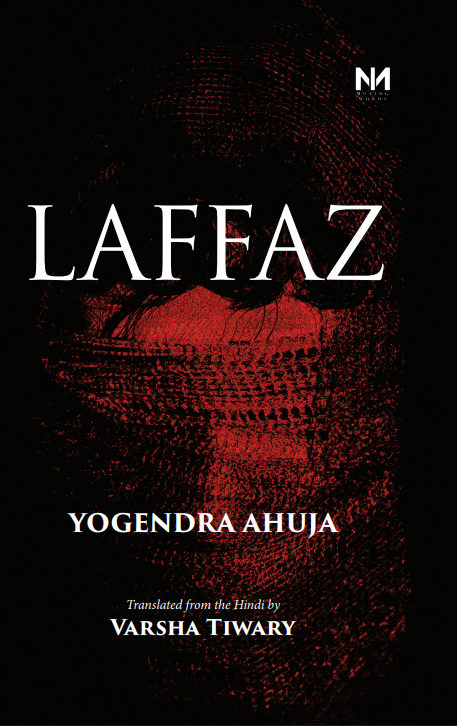
₹249.00
Yogendra Ahuja’s Laffaz explores deception as a social phenomenon, portraying a shapeshifting figure of fluent falsehood with sharp insight and narrative tenacity.
In stock
| Author | |
|---|---|
| Translator | |
| Language | |
| Format | |
| Pages | 76 |
| ISBN | 9789349203754 |
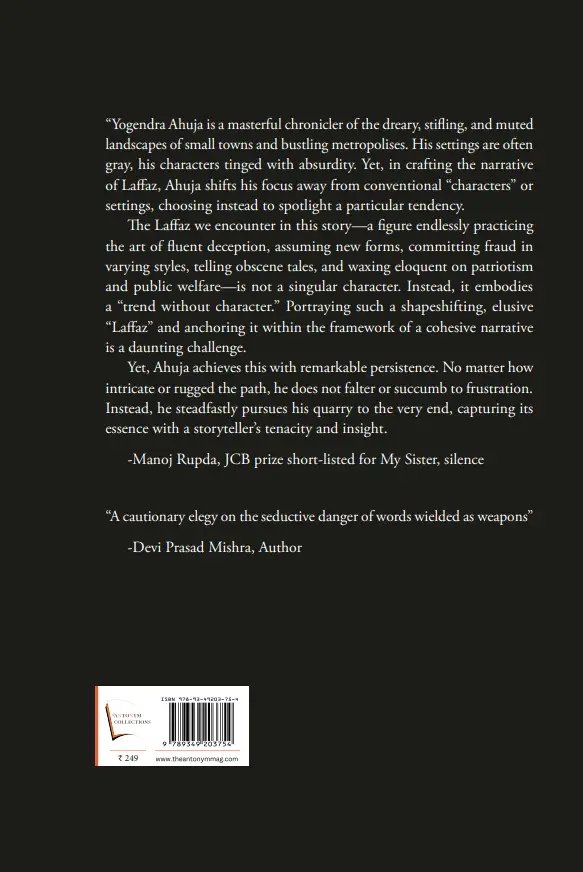
“Yogendra Ahuja is a masterful chronicler of the dreary, stifling, and muted landscapes of small towns and bustling metropolises. His settings are often gray, his characters tinged with absurdity. Yet, in crafting the narrative of Laffaz, Ahuja shifts his focus away from conventional “characters” or settings, choosing instead to spotlight a particular tendency. The Laffaz we encounter in this story—a figure endlessly practising the art of fluent deception, assuming new forms, committing fraud in varying styles, telling obscene tales, and waxing eloquent on patriotism and public welfare—is not a singular character. Instead, it embodies a “trend without character.” Portraying such a shapeshifting, elusive “Laffaz” and anchoring it within the framework of a cohesive narrative is a daunting challenge. Yet, Ahuja achieves this with remarkable persistence. No matter how intricate or rugged the path, he does not falter or succumb to frustration. Instead, he steadfastly pursues his quarry to the very end, capturing its essence with a storyteller’s tenacity and insight.
Read a review of this book by The Wire Here
The Urdu word laffaz has no English equivalent. A person garrulous, eloquent, and capable of holding an audience in thrall, is the one called a laffaz, but the word also has a whiff of the negative. A laffaz also implies someone who strips out meaning from words held in reverence by others with his shallow charm. For him, words are frivolous fluff, mere means to impress and hypnotise his audience. Mere tools to deceive, manipulate and exploit others. His apparently weighty but devoid of substance words estrange the act of communication from decency, sincerity and trust that form the bedrock of all human interaction. All these subtexts are laid bare in Yogendra Ahuja’s novella, Laffaz, a character study of a smooth-talking charlatan who weaves a silken web of words to gain—and then abuse— people’s trust, in the process destroying their lives, careers, and reputations forever. In a world where human beings hunger for deeper meaning, the charlatan makes use of this very yearning to gain a hold over his victims’ imagination, rendering them incapable of sensing oncoming disaster. That a word spinner can destroy not just individual lives but entire civilizations is delicately hinted at. Glib narratives leached of substance, can misdirect impressionable citizens hungry for betterment and engage them in false quests of ‘taking revenge against history’ from ‘outsiders,’ thereby deflecting day to day issues impinging on present day peace, personal liberty and even future prosperity . Laffaz forces us to ponder over the rampant crisis of meaninglessness in our times. Along with the hypnotic power of lies, the story explores the fate of the duped and the moral repercussions of an existence in which meaning is hollowed out from words. As such, it is metaphorical of our times. While translating Laffaz, I realized that a translator is the opposite of a laffaz. She must mine every bit of meaning from the writer’s words to recreate their force and resonance in another language and to keep expanding the boundaries of understanding between two different tongues. In that quest, I decided with my editor that the title Laffaz should stay untranslated because what follows reveals every shade of meaning the word embodies.
Varsha Tiwary
New Delhi
Hailing from Badayun in Uttar Pradesh, Yogendra Ahuja has been writing Hindi short stories since 1988. His first story, “Cinema-Cinema,” was published in 1991 in the prestigious Hindi journal Pahal. His widely acclaimed first collection, Andhere Mein Hansi, came out in 2004. His second collection, Paanch Minat aur Anya Kahaniyan, in 2014, Laffaaz aur Anya Kahaniyan was published by Aadhar Prakashan in 2019. His collection of nonfiction prose, Toot-te Taaron Tale, was published in 2023 by Navarun Prakashan, Delhi.
His stories “Marsia,” “Galat,” “Khana,” and novella, Laffaaz have been translated into multiple languages and adapted for dramatic performances by the National School of Drama and various theater groups.
Among the several honors conferred on his work are: The Katha Award, the Anand Sagar Kathakram Award, the Parivesh Samman, the Spandan samman, the Premchand Smriti Samman, Ramakant Memorial Award, and the Vijay Verma Katha Samman.
Writer-translator Varsha Tiwary lives in Delhi. Her first book-length translation,1990, Aramganj, was brought out by Eka, Westland, in 2024. A recipient of HWR Emerging Writers Fellowship, 2025, she is also working on a fiction project.
Share this product with others



Anshika Mehta –
The enigmatic tale Laffaz, penned by Yogendra Ahuja, is an exploration of a man whose identity is defined by his shifting narratives. Written against the backdrop of an Uttar Pradesh torn by politics and religion, this story beautifully envelops the undertones of communal violence and gender discrimination. The tale focuses on a young bank manager in a small town who spends his life trying to uncover the actual story behind the ‘word spinner’ or ‘Laffaz’. What starts as a cat-and-mouse chase soon transforms into a revelation that makes the manager question his ideas of morality, truth, and justice. Written in a way that keeps its readers hooked until the last page, Laffaz is a story that comes quite rarely. The author beautifully weaves the tale by carefully constructing its characters, giving them depth and human flaws. The tale, while focusing on giving dimensions to the characters, also paints the image of a town that is yet to be developed. The nuanced depiction of the destruction and then the subsequent construction of the town helps the readers in grasping the shifting timelines and makes the story seem even more realistic. The spinning narratives give a character like ‘Laffaz’ a multidimensional depth and make the readers question their understanding of deception, just like the bank manager.
Originally written in Bengali and translated into English by Varsha Tiwary, the novel doesn’t ruin its originality and rawness. The glim settings and grey characters of Yogendra Ahuja shine through even in the translation, and the imagery remains intact.
Overall, Laffaz is a story for those who wish to understand the complex layers of a person’s personality. The Urdu word ‘Laffaz’ translates to a spinner of words, and that is exactly what the main character does in this book; he creates multiple stories and identities in order to live a life built on lies, destruction, and deception. A tale of not just a man but a metaphor for the entire society, this is a story that remains with its readers long after it is read.
To me the book was more than just a story, it was a mirror that reflected what the world hides from us. The constantly shifting narratives and the grey characters felt like the real world and kept me hooked till the end. I would recommend this book to everyone who wishes to not just read but also feel a book to its core. Laffaz is a creation that comes quite rarely.
koushani –
Reading Laffaz was a really unique experience for me. At its core, it isn’t just the story of a single smooth-talking conman, but also a sharp commentary on how easily people and even entire systems can be manipulated by words. The character of Laffaz, the “word spinner,” is unsettling because he feels so real. He is not just a fraudster who cheats a bank; he is a figure who embodies the dangers of empty rhetoric, the kind that can sway people, ruin careers, and even destabilize communities.
What struck me most is how the story moves between the personal and the political. On one level, it is about the narrator’s encounters with Laffaz and the devastating effect he has on a simple, honest bank manager’s life. On another level, it reflects on how manipulative narratives can mislead whole societies, especially in times of unrest and crisis. The parts about the demolition of the mosque and the communal atmosphere gave me chills because they connect so directly to the misuse of words in real historical and contemporary contexts.
The translation by Varsha Tiwary deserves credit too. She explains in her note that a “laffaz” is someone who plays with words, sometimes charmingly, but often deceptively. She manages to capture both the charisma and the hollowness of such a character in English without losing the cultural depth of the original Hindi.
As a student, I found myself reflecting on how relevant this story is today. We live in a time where speeches, social media, and “viral” words often matter more than truth, and Ahuja’s novella makes us question our own vulnerability to such manipulation. It’s not a light or easy read as it demands patience but it rewards you by leaving you with questions that linger long after you finish.
Overall, Laffaz is more than just a character study; it’s almost a warning. It shows us how dangerous it can be when words are divorced from sincerity, and how much damage a single “word spinner” can cause.
~ Koushani Chakraborty