No products in the cart.
Return To Shop

No products in the cart.
Return To Shop
No products in the cart.
Return To Shop
Bridge to Global Literature
No products in the cart.
Return To Shop
Bridge to Global Literature
No products in the cart.
Return To Shop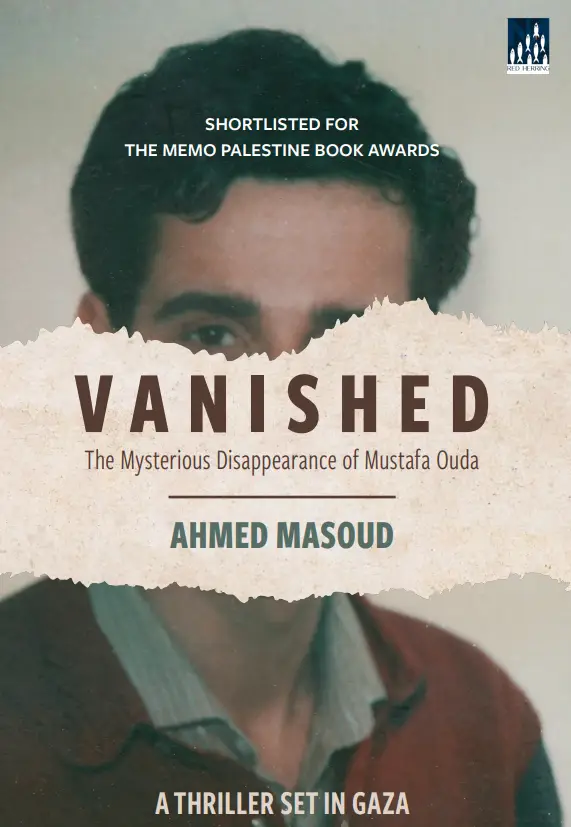
₹499.00
Ahmed Masoud’s Vanished is a gripping political thriller about a boy seeking justice amid war, secrets, and betrayal.
In stock
| Author | |
|---|---|
| Language | |
| Format | |
| Pages | 228 |
| ISBN | 978-93-49203-01-3 (India) |
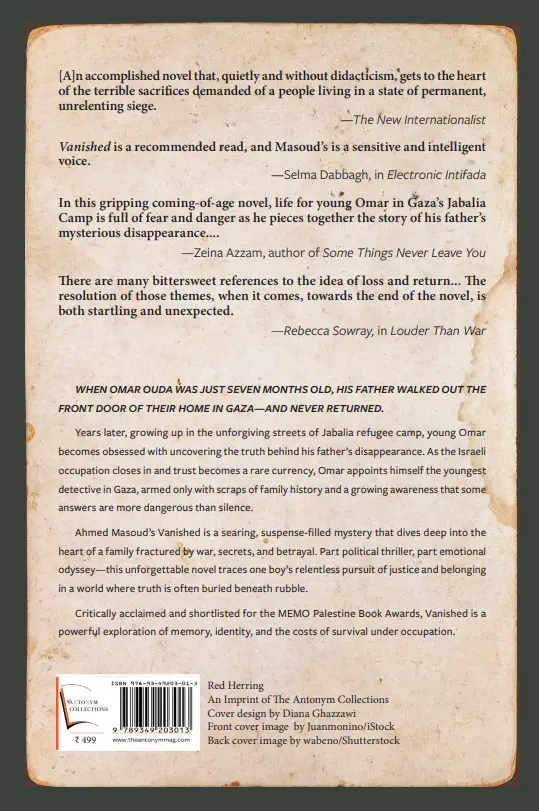
Ahmed Masoud’s Vanished is a searing, suspense-filled mystery that dives deep into the heart of a family fractured by war, secrets, and betrayal. Part political thriller, part emotional odyssey—this unforgettable novel traces one boy’s relentless pursuit of justice and belonging in a world where truth is often buried beneath rubble.
“Mixing a thriller story with the reality of life in the Palestinian occupied territories. Vanished is a novel which can be enjoyed by a wide public, not only by people interested in the Arab world.” —Banipal Magazine (London)
“In this gripping coming-of-age novel, life for young Omar in Gaza’s Jabalia Camp is full of fear and danger as he pieces together the story of his father’s mysterious disappearance. While navigating the machinations of a brutal Israeli military occupation and growing up among resistance fighters as well as collaborators, Omar has to make impossible choices and learns painful lessons…” —Zeina Azzam, author of Some Things Never Leave You
“Vanished takes the reader deep into Gazan society…. and the suspense is maintained until its final pages.” —The Tanjara “Masoud is skilful at building up suspense; he drops no early hints of what happened to Omar’s father.” —The Jordan Times
“There are many bittersweet references to the idea of loss and return: the lost country, the lost father. The resolution of those themes, when it comes, towards the end of the novel, is both startling and unexpected.” —Rebecca Sowray, in Louder Than War
“Vanished is an accomplished novel that, quietly and without didacticism, gets to the heart of the terrible sacrifices demanded of a people living in a state of permanent, unrelenting siege.” —The New Internationalist (London)
 Ahmed Masoud is the author of the acclaimed novels Vanished: The Mysterious Disappearance of Mustafa Ouda and Come What May. He is a writer, poet, and director who grew up in Gaza, Palestine and moved to the UK in 2002. His theatre and radio drama credits include The Florist of Rafah (2024), Passports, Jinn, Mo Salah and Other Complicated Things (2023), Application 39 (WDR Radio, Germany, 2018), Camouflage (London, 2017), The Shroud Maker (London, 2015 and still touring), Walaa, Loyalty (London, 2014, funded by the Arts Council England), and Escape from Gaza (BBC Radio 4, 2011). Ahmed was the founder of Al Zaytouna Dance Theatre (2005– 13), for whom he wrote and directed many productions with tours in the UK and Europe, including Unto the Breach (London and Vienna 2012), Between the Fleeting Words (London, Zurich, Freiburg, Ljubljana, Madrid 2010–2012), Ila Haif (London, Freiburg 2008–2010), and Hassad (London 2007–2008). After finishing his PhD research, Ahmed published many journals, including a chapter in Britain and the Muslim World: A Historical Perspective (Cambridge Scholars Publishing, 2011). Most recently, he launched a new artistic initiative called PalArt Collective. His personal website is www.ahmedmasoud.
Share this product with others

Samadrita Kanjilal –
“Vanished”, a fiction, comes out at that crucial juncture in time here, which makes it a definite read for once at least, in order to know what the atrocities are being faced by the citizens of Gaza, since 1980s. The story revolving around the protagonist Omar, not only speaks for who he is, how his identity goes through a continuous state of flux, tension and crisis, but also gives an imagery of how Gaza in itself goes through a continuous state of stress and storm till this day. The book might come with an easy-flowing, readable component with vivid imagery of the horror faced by a child first then a teenager recounted from an adult’s perspective (all of them are Omar here) in letters to his son while being on a flight to return to his homeland Gaza from England in order to get the last trace to his roots, his father, for whom he waited all his life, amid ongoing severe political tensions between Palestine and Israel, but what stuns the most is how the tale take a turn of events eventually and leads one to the ultimate climax, which is heartbreaking on one hand and on the other, leaves one pondering over how roles, identities and agenda of a human in society shifts and some times overlaps with socio-economic-political situations in the world.
What stands even more fascinating in the read is that the author tried to draw parallels between fantasy and ongoing horrors in Gaza strip, particularly which caters to child-teen Omar during the 80s and takes episodes from the renowned “Panchatantra” to elucidate on certain metaphors which are evident on the face of it, self-explanatory and enjoyed best when left at their own disposal without further intervention, subject to the reader’s own interpretation. The crisp, lucid languid structure of the read not only helps one understand and keep it in conscience what it actually takes for the people of Gaza to go through or encounter all those horrendous occurances regularly but also instills a poignant, crucial yet images of sad state of affairs in one’s head that though the story is based in 1980s Gaza, yet the situation up until now in 2025 has not changed much and that constant talk of it, raising questions, fighting for the people, keeping the issue alive in collective memory across the world now is of utmost importance in order to give some respite to children like Omar, who doesn’t have to go through the burden of carrying the “memory of a child” all through their life and turn it into a book eventually, all single-handedly.
Paulami Den –
Ahmed Masoud is an award-winning writer who grew up in the Gaza Strip; his writings reflect this vividly. It is a complete gain of experience while reading Vanished: The Mysterious Disappearance of Mustafa Ouda. Based on the setting of London, United Kingdom, where Mustafa was growing up and nurturing the mystery of his father’s disappearance. Being the protagonist, he is a character with shades, which makes him quite interesting to a reader. The whole work of fiction is a roller coaster ride which takes the reader through the grief and the entangled political situation of Gaza.
The novel Vanished: The Mysterious Disappearance of Mustafa Ouda starts with the search and concern for a photograph of Omar, who is the father of Mustafa. The flight of Omar and Zoe enlightens us about the condition of by then Gaza and the refugee camp in the UK. Mustafa and his mother, Zoe, were left in London by Omar. Mustafa was a mere four-year-old child by then who was completely unaware of the ‘photograph’. Later, the novel develops with the maturing of Mustafa and his search for his father. This novel reflects the time period of the 1980s and continues a few decades from that era. A reader will find the desire to read this novel after connecting with Mustafa in a cognitive manner. The author, Ahmed Masoud, beautifully weaves all the threads of incidents experienced by Mustafa. It is an incredible documentary where the situation of Gaza at that time is explicitly described. The tension which is set throughout the text helps the reader to finish the book in one read. Omar’s morality and psychological development is a complete dissection of a child’s mind to adulthood by Masoud.
Emergence of various characters in the plot in a chronological manner acts as a stair to Mustafa’s mind. Rotational appearance of Omar’s perspectives brings relief from the monotonous form of reading. Suspense and grief intermingled with the struggle of Mustafa’s existence, where Omar’s life is a reflection of Masoud on a slight note. However, the reflection of his personal life is yet a discussion which can be curtailed by the author himself. We, the readers, can only assume and interpret, but Vanished: The Mysterious Disappearance of Mustafa Ouda will be forever in a reader’s mind as it leaves a scratch deep in the heart. The way a mere object like a photograph flourishes into an impactful novel is worth praising. Originally published in the year 2015, Vanished: The Mysterious Disappearance of Mustafa Ouda is still a book of interest to millions, and it will remain so for years. Since this book is not a meagre work of fiction but a documented text to know history regarding the political situation of Gaza and the terrorism of Palestine. Readers interested in knowing the Arabian World will surely feel engrossed towards this book, where the struggle of each Palestinian refugee is portrayed through primary characters such as Mustafa and Omar.