No products in the cart.
Return To Shop

No products in the cart.
Return To Shop
No products in the cart.
Return To Shop
Bridge to Global Literature
No products in the cart.
Return To Shop
Bridge to Global Literature
No products in the cart.
Return To Shop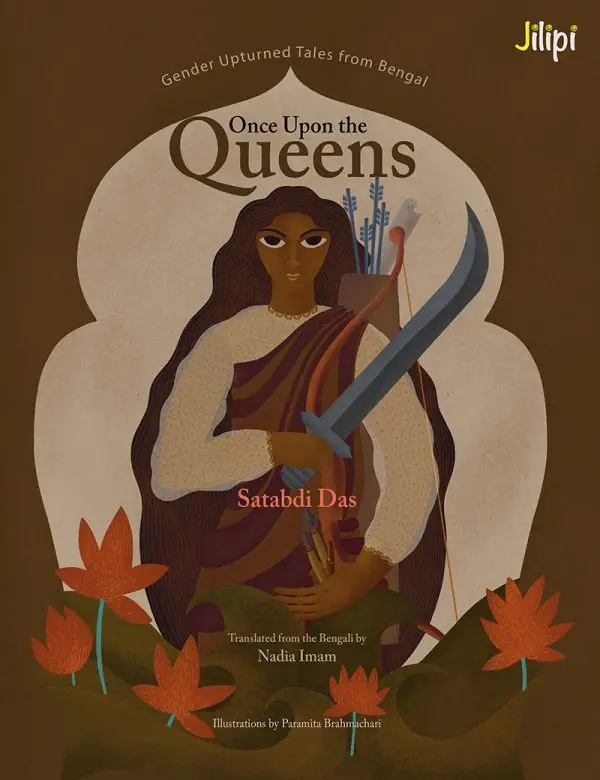
₹849.00
Once Upon Queens reimagines Bengali folklore with heroines of resilience and wisdom. Satabi Das retells classic tales for new generation.
In stock
| Dimensions | 28 × 22.5 × 1.3 cm |
|---|---|
| Author | |
| Translator | |
| Illustrator | |
| Language | English |
| Format | Hardback |
| Pages | 124 |
| ISBN-13 | 9788197684890 |
In this captivating collection, Satabi Das masterfully re-imagines timeless tales from Bengal, turning classic narratives on their heads to highlight the strength, resilience, and agency of female protagonists.
From princesses who wield wisdom instead of weapons to queens who seek their own destinies, each story sheds new light on Bengal’s rich cultural heritage while challenging traditional gender roles.
Translated from the original Bengali into English by Nadia Imam, Once Upon the Queens offers readers a rare, yet refreshing glimpse into Bengali folklore. Take a journey through these upturned tales to step into a world where heroines claim their stories, save kingdoms, and rewrite history. Perfect for readers of all ages, this collection is a bold testament to the power of storytelling to inspire change.
Experience Bengali folklore as you’ve never done before.
A Kolkata-based story-teller. Is professionally entrusted to help in the learning of the pupils, but is more akin to aid in their unlearning. A Disrupter. Unsettles things for six days a week and recreates them on the seventh day. The same has been done here with the renowned Bengali folklore. This is how fairy tales read when retold by the granddaughter of ancient witches.
A translator bringing her first translated work to life with a wish for happily-ever-afters all around! She is based in Kolkata and has an English literature degree. Nadia aspires to change the world, one word at a time. She dreams of closing cultural divides through translation so that every tale she touches has a chance to connect, uplift, and leave readers a little more hopeful.
A student of first literature, and then film from Jadavpur University, Paramita Brahmachari comes pre-addicted to all the good books and visuals. Despite having only a doctorate in Film Studies, and no training at all in graphics, she has been making covers since 2016, mostly as an excuse for reading yet more books, and imagining how stories unfurl in lines and colours.
She has won the Oxford Bookstore and the Publishing Next awards for cover design, but this is her first time ever illustrating for children.
Share this product with others


koushani –
“Once Upon the Queens: Gender Upturned Folktales from Bengal” by Satabdi Das, translated by Nadia Imam, is a fascinating attempt to reimagine traditional Bengali folktales through a feminist & socially conscious lens. Rather than simply reproducing the century-old tales from Dakshinaranjan Mitra Majumdar’s “Thakumar Jhuli,” the author restructures them to challenge the rigid binaries of “good” v/s “evil” and “male hero” v/s “passive princess” that have long dominated folklores.
One of the most striking elements is the book’s opening essay, which reflects on the function of fairy tales as moral lessons, Das points out how these stories often reinforce social hierarchies and gender stereotypes like princesses who wait helplessly and princes who must prove themselves through violence or impossible feats. The author questions whether these ‘values’ still hold meaning in a world where we now recognize ideas like consent, equality and shared responsibility. This framework sets the stage for the retellings that follow ahead.
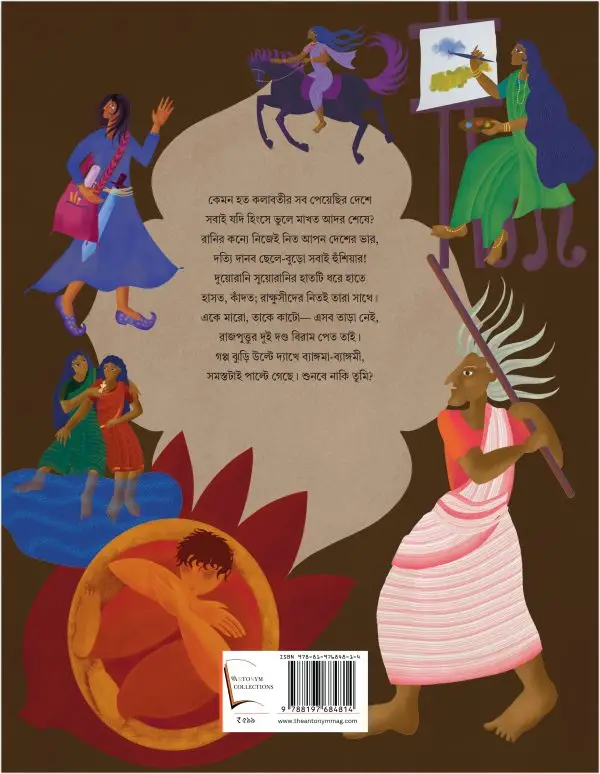
The retold stories themselves flip familiar tropes. For example, in “The Sleeping Kingdom,” the roles are reversed: instead of a passive princess waiting to be awakened by a prince, it is the princess who sets out on an adventurous journey, armed with a sword, paints and parchment and ultimately awakens a sleeping prince and his kingdom. What stands out is how she is guided not by love at first sight or destiny but by curiosity, consent and courage.
Similarly, in “Princess Kalawati,” the narrative no longer sidelines her in favor of the Buddhu-Bhutum brothers’ adventures. Instead, Kalawati becomes a sovereign leader with her own voice, court and decisions. These revisions shift the focus away from patriarchal heroism toward agency, compassion and justice.
Another recurring theme is the challenge of social boundaries whether between kings and commoners, men and women, or “good” and “bad” girls. The story of “Kanchanmala, Kakanmala” emphasizes friendship and forgiveness while tearing down the walls between royalty and peasantry. Here, the so-called “bad girl” is no longer condemned. Instead, the narrative reveals that both girls carry goodness and flaws, breaking away from the old binary moral lessons.
What makes the book unique is that it isn’t just rewriting for the sake of modernity. It’s deeply rooted in Bengal’s folk storytelling tradition while also speaking to today’s issues. Das acknowledges the influence of Disney and global entertainment, which have reshaped fairy tales for mass audiences but often erase local contexts. By retelling Bengali folktales with a feminist perspective, she brings back indigenous stories while ensuring they resonate with contemporary readers.
Overall, this book reads like both a nostalgic return to folklore and a radical rethinking of its cultural impact. It is at once playful and serious, critical and imaginative. It pushes us to think about how stories shape our values and why it matters who gets to tell them. Das not only revives forgotten tales but also redefines what it means to live “happily ever after…”
~ Koushani Chakraborty